

Every prompt LOCLshop tracks carries an estimated monthly search volume. That number answers one question: how many people in this location’s trade area are asking this question each month? The higher the volume, the more the answer is worth — and the more expensive it is to be absent from it.
The estimate is assembled in three layers:
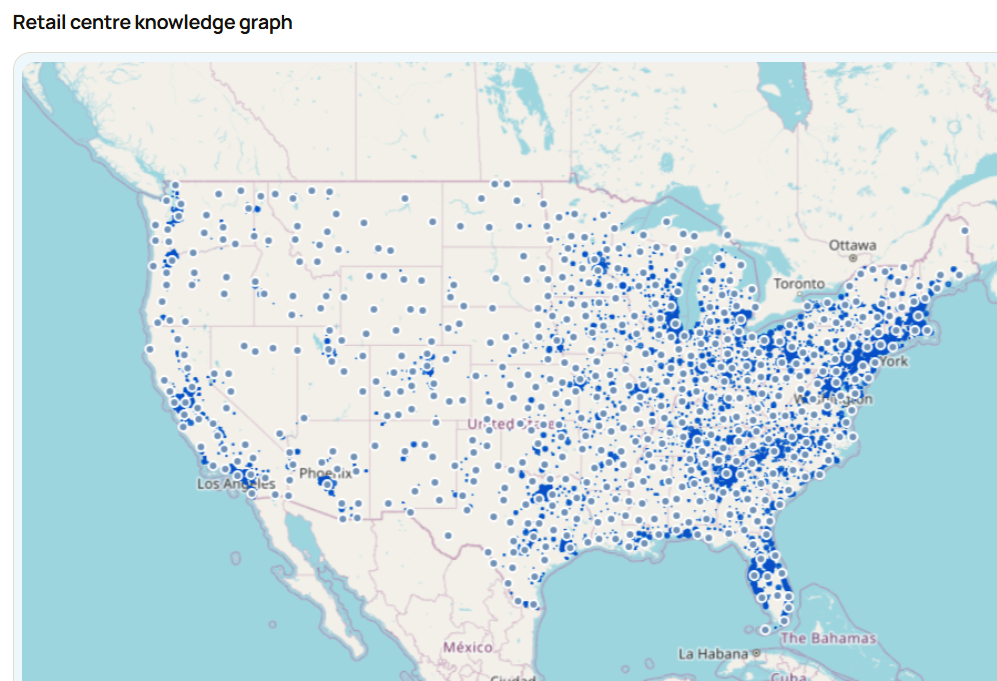
Layer 1: Shopper intent from LOCLshop’s Retail Center Knowledge Graph.
Layer 2: Keyword volume from Google Keyword Planner geo-scoped to the location.
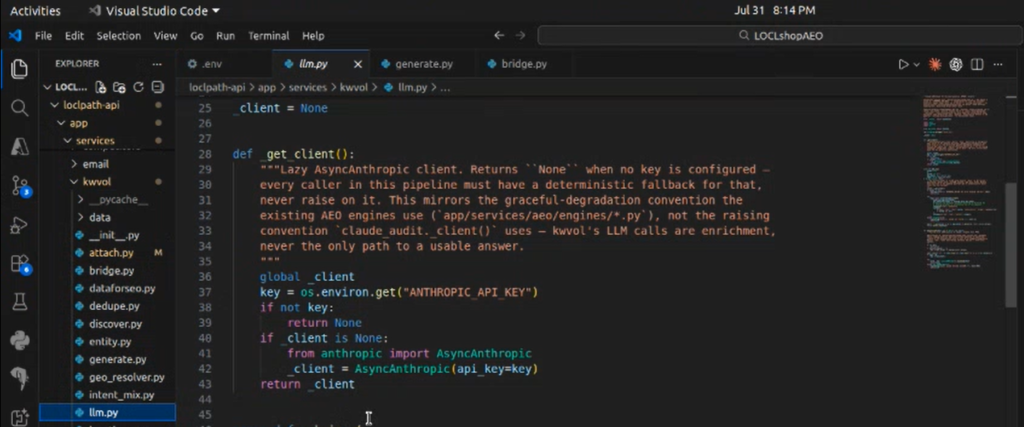
Layer 3: A proprietary engine that composes ranked keywords into prompts a person would plausibly type. The prompt inherits volume from the keywords behind it.
Proprietary engine that composes ranked keywords into prompts
| The layer that makes this checkable Google Keyword Planner is public. Any agency with a Google Ads account can open it, apply the same geography, and verify our keyword volumes independently. Where our number differs from a direct lookup, the difference is the composition step in Layer 3 — not an adjustment in our favor. |
Why location by location volume analysis is essential for AI Search Share of Voice improvement compared to nationwide brand-level volumes
A brand-level volume figure is easy to produce and almost useless. Aggregated across an estate, a multi-location brand can show tens of millions of monthly searches against prompts like “fun educational attractions for families” — real, large, and unactionable, because no single location can act on it and no competitor can be identified from it. What the brand cannot see is whether the Denver location is returned to a person in Denver, and which venue is returned instead. So volume is scoped to the location from the first step rather than aggregated and divided. Every keyword pull, prompt composition and score executes against a maintained location code — Denver’s prompt set and Orlando’s are different sets, ranked by different volumes, against different competitors.
The three layers
Layer 1 · Intent — the Retail Center Knowledge Graph
LOCLshop has tracked shopper attributes and campaign response across 14,035 U.S. retail centers for three years. That history is what tells us which search language shoppers in a given trade area actually respond to, as distinct from the language a brand uses about itself.
This layer produces relevance, not volume — the filter deciding which keywords are worth pricing in Layer 2. It is also the part that cannot be replicated from public sources, because the underlying panel does not exist outside LOCLshop.
Layer 2 · Keywords and geo-scoped volume
From the brand’s category, site content and stated customer intent, combined with the relevance filter above, the platform generates a working set of roughly 400 to 600 candidate keywords per location.
Each keyword is then priced through Google Keyword Planner using a twelve-month trailing average, geo-scoped to the location’s market. Keyword Planner supports geography by city, DMA and ZIP; LOCLshop selects the tightest available scope that approximates the location’s trade area and records which scope was used. Keywords are then ranked by volume.
Layer 3 · Prompt composition and naturalness
Ranked keywords pass to a proprietary multi-layer engine that composes them into prompts. Three things happen here.
- Bundling. A single prompt typically carries eight to ten keywords. Two or three related keywords frequently resolve into one prompt, because people ask one question rather than typing three fragments.
- Humanisation. The engine writes the prompt the way a person would ask an assistant, not the way a keyword tool would concatenate terms. “Museum” and “illusions” become a question, not a string.
- Naturalness verification. Each candidate prompt is tested across the five tracked answer engines — ChatGPT, Gemini, Perplexity, Copilot and Claude — to confirm it behaves like a naturally occurring question rather than a machine-generated one. Prompts that fail this test are discarded.
The surviving top ten prompts per location are then locked. Locking matters: a prompt set that drifts week to week cannot be used to measure improvement, because every change in score would be confounded by a change in what was measured.
From keywords to a prompt’s monthly volume
A prompt’s volume is derived from the keyword bundle behind it, not from any single keyword. Because several keywords can resolve into one prompt, and because those keywords are deduplicated before aggregation, a prompt’s figure will not match a direct one-keyword lookup in Keyword Planner. That divergence is expected and is a property of the composition step, not an error.
The figure is then reconciled against observed answer-engine behaviour for that prompt in that market, and displayed with an information marker linking to this paper — precisely because it is an estimate and should be read as one.
Worked example — Museum of Illusions, Denver
Denver’s ten locked prompts carry an estimated 235,800 searches per month inside the trade area. The distribution is steep, which is typical:
| Est. monthly volume | Share of location total | |
| Top five prompts, combined | ~201,000 | ~85% |
| Remaining five prompts | ~35,000 | ~15% |
| All ten tracked prompts | 235,800 | 100% |
Five of the ten carry a negative AI search gap against the named Denver competitor, and those five account for roughly 200,000 of the 235,800. The reading is direct: the great majority of this location’s addressable AI search demand sits on questions it is currently losing. The remediation queue is ordered accordingly — gap size multiplied by prompt volume, worked in descending order.
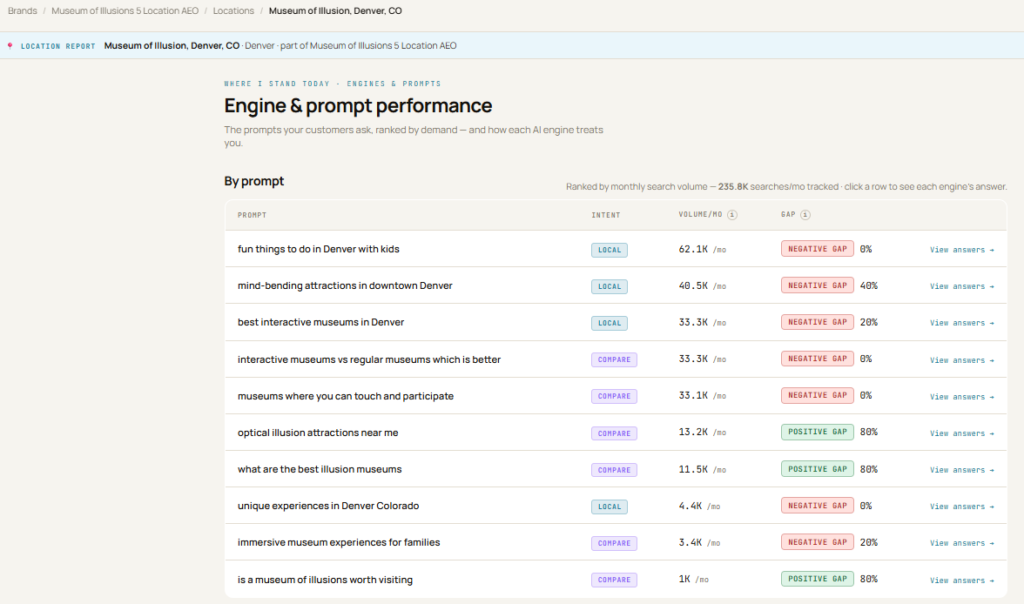
Note what volume ranking exposes what a brand-level view conceals. Denver scores well on category language — illusion-museum phrasing — which carries little volume, and poorly on occasion language, what to do in Denver with children, which carries the most. It owns its category and loses the occasion.
What this number is, and what it is not
- It measures search demand, not assistant traffic. No public source reports query volume inside the answer engines. Keyword Planner is the best available proxy for what a market asks — and it is a proxy.
- It is an estimate, built for ranking rather than forecasting. Keyword Planner reports ranged, rounded, trailing figures. The number exists to order ten prompts against each other and weight the remediation queue, not to project sessions, visits or revenue.
- The geography is an approximation. Keyword Planner scopes by named geography; a trade area is a radius. LOCLshop uses the tightest available scope and discloses which, per market.
The position, stated plainly. This is LOCLshop’s informed opinion of what a market’s highest-volume questions are, and roughly how often they are asked. It is offered as an opinion that can be argued with, not a measurement that cannot — and where a client’s own data contradicts ours, the client’s data should win.